Electronic Documents
Standards & Rules
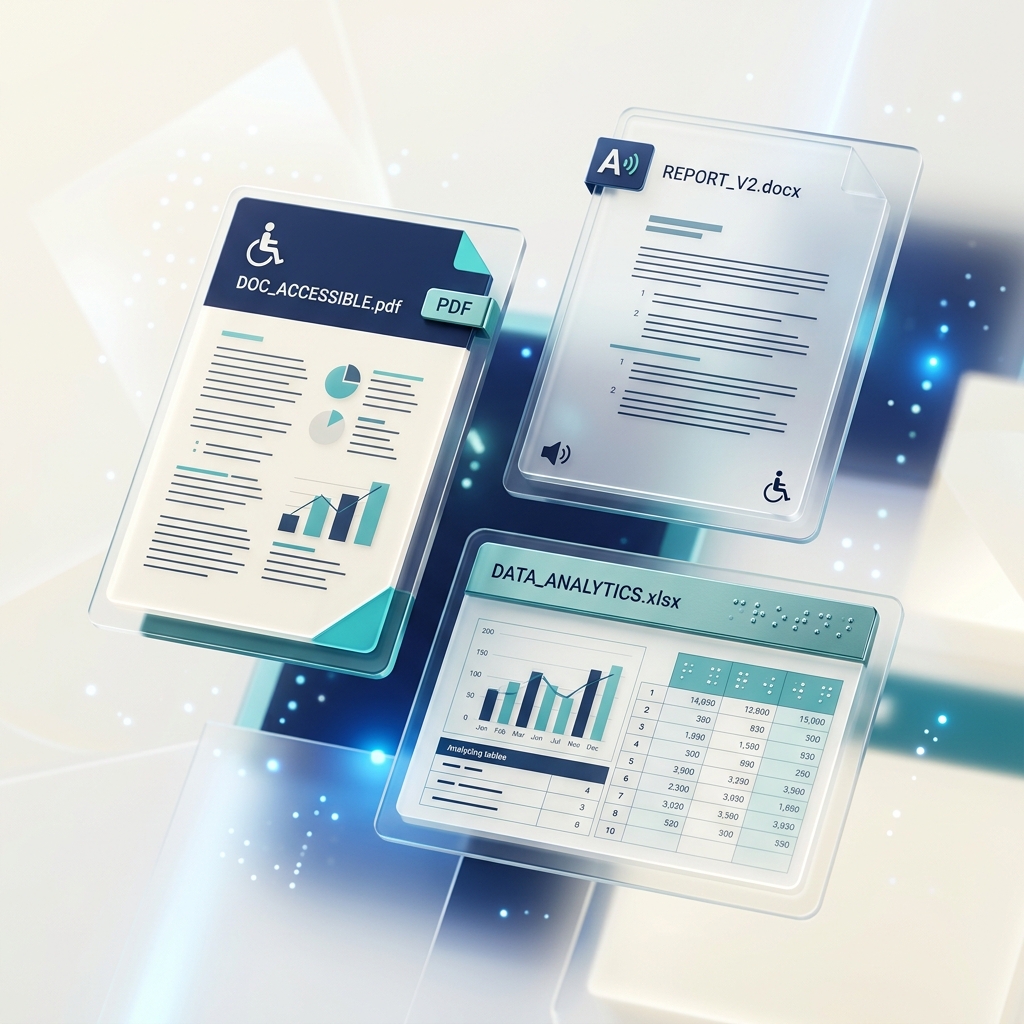
Accessibility doesn't stop at your website. Every PDF, Word document, and spreadsheet you share must be usable by everyone.
The Governing Rules
Electronic documents fall under several legal and technical frameworks. Understanding these is the first step toward compliance.
ADA Requirements
Under the ADA, "effective communication" is required. If a document is part of a public service or accommodation, it must be accessible. The new Title II rule explicitly includes documents shared on government platforms.
Section 508
Applies to federal agencies and any organization receiving federal funding. It mandates that all electronic and information technology, including documents, be accessible to people with disabilities.
WCAG & PDF/UA
WCAG 2.1 Level AA is the technical benchmark. For PDFs specifically, PDF/UA-1 (ISO 14289) provides the international standard for universal accessibility in document files.
Document Expectations
An "accessible" document is more than just readable text. It must have a semantic structure that assistive technologies can interpret.
Tagging Structure
Every element (headings, paragraphs, lists) must be tagged correctly to define the logical reading order.
Alternative Text
All images and non-text elements must have descriptive alt text or be marked as decorative.
Language Specification
The document must have a declared primary language so screen readers use the correct pronunciation.
Common Expectations by File Type
| Feature | Word | Excel | |
|---|---|---|---|
| Heading Styles | ✓ | ✓ | - |
| Alt Text | ✓ | ✓ | ✓ |
| Table Headers | ✓ | ✓ | ✓ |
| Document Title | ✓ | ✓ | ✓ |
| Color Contrast | ✓ | ✓ | ✓ |
The Exceptions
While accessibility is mandatory, there are specific scenarios where rules may vary or temporary exceptions exist.
Archived Content
Documents that were published before a specific date and are no longer being updated or used for current business processes may be exempt from immediate remediation, provided they are clearly marked as archived.
Third-Party Content
Content provided by users or third parties that is not under the control of the organization (e.g., a public forum attachment) may have different liability rules, though organizations are still encouraged to provide accessible alternatives.
Experimental/Draft Content
Internal drafts or collaborative working documents that are not yet "finalized" for public distribution may have temporary leeway, but accessibility should be "baked in" from the start of the creation process.
Start Remediating Today
Don't let inaccessible documents put your organization at risk. We can help you audit, tag, and fix your entire document library.